
Turning a Memphis Name Into Leads
Memphis is the Shelby County seat, and that fact shapes nearly every local search. The city keeps municipal citations, permits, police reports, and its own administrative files. Shelby County keeps deeds, property appraisals, marriage licensing, probate, most trial-court files, and election administration. Start with the type of fact already known, not with one broad request for everything tied to a name.
A full name is often enough for a first pass through deeds, appellate cases, state licenses, or business filings. An old street address calls for the Assessor and parcel map first. A family-history question may move at once to probate, vital-record indexes, newspapers, and city directories. Write down the date range, name variants, and each record number found. Those details make a phone call or counter request far more useful.
- Search the Shelby County Assessor by owner or address, then save the parcel ID and note whether the owner mailing address differs from the property address.
- Check the Register of Deeds by party name, document number, book and page, instrument type, or recording date.
- Choose the court division that fits the event before searching a party name or contacting a clerk.
- Use probate, archived vital indexes, newspapers, and yearly directories when the goal concerns kin or a past Memphis resident.
- For files not indexed online, ask the exact custodian for inspection or a defined copy by name, date range, and identifier.
Memphis People Records by Office
The county office split prevents many false dead ends. The Register holds recorded instruments and permanent archival databases. The Assessor ties a listed owner to a parcel, but its roll is not proof of current title or present occupancy. Memphis city departments hold permits, correspondence, rosters, and municipal files. The detailed access rules belong with the Memphis public records system, while these contacts provide the first routing points for a people search.
Shelby County Register of Deeds
1075 Mullins Station Road
Building W3, Suite W165
Memphis, TN
(901) 222-8100
Land records and archives gateway
Memphis City Records
Law Division routing
Weekdays, 8:30 a.m. to 5 p.m.
(901) 636-6616
For older city and county series, move from the web gateway to the Archives counter. For non-indexed city material, use the online request portal or call the Law Division. The Shelby County Clerk is the route for marriage licenses and several local business functions; its official service gateway identifies the right division.
Note: Call ahead when a file may be archived, restricted, or held by a separate clerk rather than the office named in an old index.
Searching Memphis Deed Parties
A recorded-land search can connect a person with an acquisition, transfer, mortgage, lien, power of attorney, affidavit, or other filed instrument. In index language, the grantor gives or conveys an interest, while the grantee receives it. Search both roles and use an approximate date when common names produce many hits. A document number or book and page points staff to one filing.
The Shelby County Register gateway is the online starting point. Some images or services may require an account or fee, and the accessible landing page does not publish one start year for every database. If an older volume has no web image, preserve the indexed name, instrument type, date, and book/page. Then call the Register, visit its counter, or ask the Archives to retrieve the record series.
The official Register screen shows how current land records and historical databases share one gateway.

The capture is a useful starting view, but an index entry is not the same as a certified copy or a complete title finding.
- Index
- A finding list that points to a filed record; it may not display the full image.
- Instrument
- A recorded document such as a deed, mortgage, lien, plat, or affidavit.
- Book and page
- The filing location used to retrieve a record from a recorded volume.
- Certified copy
- An official copy authenticated by the custodian, distinct from an informal screen image.
From Memphis Address to Owner
An address search works best as a short chain: address to parcel, parcel to assessed owner, and owner to the latest deed. The Shelby County Assessor search can show a parcel ID, property or situs address, owner name, owner mailing address, legal description, classification, values, and available sales or building details. “Situs” means where the land is located. The mailing address is where tax correspondence goes, and it may be elsewhere.
The Assessor’s public interface is shown here with the search controls used to begin a Memphis owner lookup.
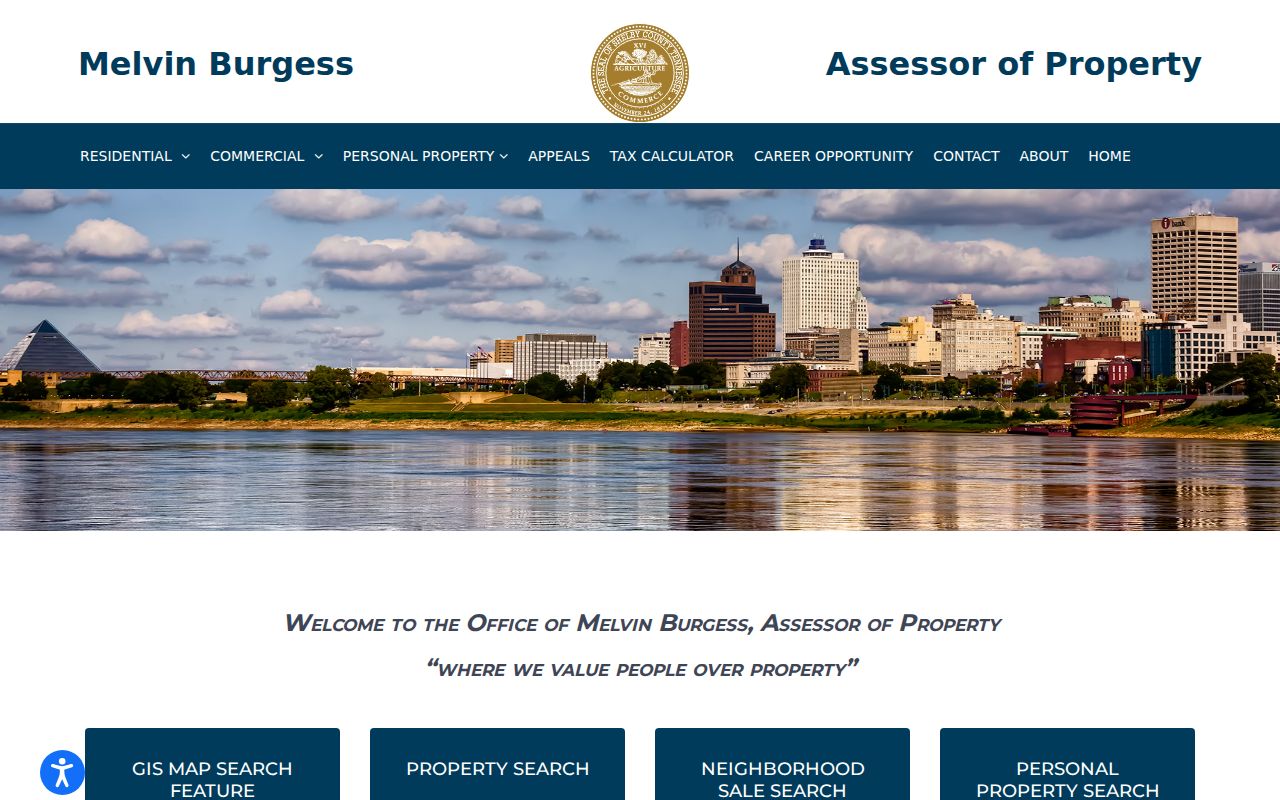
Use the returned parcel ID as the stable bridge to deeds and the official Parcel Identification GIS. Street wording can change while the parcel and legal description remain.
| GIS field or control | Input type | Use in a Memphis search |
|---|---|---|
| Find address or place | Autocomplete text | Navigate to a known address or place |
| Query Widget: Parcel ID | Text | Open a parcel by its formatted identifier |
| Query Widget: Owner Name | Text | Try a surname or entity-name variant |
| Map parcel click | Spatial selection | Open the parcel’s displayed attributes |
| Layer List | Expandable control | Turn available map layers on or off |
Why Memphis Property Search Misses People
Property rolls are powerful, but they do not represent all Memphis residents. Census research in the source material places owner occupancy at 44.9 percent for 2020 through 2024. That means most homes were not owner occupied, so a parcel search alone can miss renters, relatives, former residents, boarders, and anyone whose name never appeared as an owner. An entity or trust may also appear where a person’s name was expected.
For an occupant rather than an owner, pair the parcel with annual city or reverse directories, census schedules, permit records, probate, and newspapers. A standard city directory runs from surname to occupation and address. A reverse directory runs from street address or phone number to subscriber. Editions on both sides of a move can show a shift that one volume misses.
Key limit: An assessor entry proves tax-roll attribution. It does not by itself prove current title, present occupancy, or a personal relationship to anyone at the address.
Choosing a Memphis Court Search
Memphis has no single complete trial-court name index. City Court handles traffic and municipal tickets. Shelby County General Sessions, Circuit, Chancery, Criminal, Probate, and Juvenile courts maintain separate records. The federal trial court is the Western District of Tennessee. First identify the issuing agency, case type, and likely court level. Then search the division’s portal or contact that clerk.
Tennessee Public Case History accepts case number, case style, individual party, or business and organization searches, but it covers appellate matters whose records were filed after September 1, 2006. It is not a statewide trial-court index. Its docket may show parties, counsel, the originating court, procedural events, dates, status, and linked motions, orders, judgments, or opinions when digitized.
| Memphis court route | Record focus | Full-file fallback |
|---|---|---|
| City Court | Municipal and traffic citations | City Court Clerk at 201 Poplar |
| General Sessions | Limited civil and criminal matters | Clerk index and counter |
| Circuit or Chancery | Civil and related matters | Respective clerk file request |
| Criminal Court | Felony prosecutions | Criminal Court Clerk |
| Probate Court | Estates and protective proceedings | Probate clerk by case number |
| Tennessee appellate courts | Appeals, not trial files | Appellate clerk |
| Western District federal court | Federal civil and criminal cases | PACER or federal clerk |
Counter terminals may contain docket events or scanned pleadings absent from a public web index. Give the clerk name variants, a filing-year range, category, and case number if known. Sealed, expunged, adoption, and confidential juvenile material will not be open. A no-result is not proof that no proceeding existed.
Memphis Probate Trails for Heirs
Probate files can be among the richest lawful sources for a family or estate question. Petitions, wills, creditor notices, inventories, and deeds may identify a decedent, relatives, representatives, addresses, and property. A decedent is the person who died. Guardianship and conservatorship files concern protected people and may be restricted, so do not assume every document named on a docket is open.
Start with the appropriate Shelby Probate route and note that research identified a portal split for matters before October 2013 and later cases. Search the name and approximate year, then ask the clerk for the estate file or a specific item by case number. If no digital result appears, check creditor notices and the Register’s deed party index, then ask County Archives about older court material. Newspapers and obituary indexes can help establish the date range, but they do not replace the filed estate record.
Note: Search initials, prior surnames, and nearby years before treating a probate no-result as meaningful.
Finding Memphis Vital Records
Recent birth, death, marriage, and divorce certificates are controlled records, not an open name directory. Shelby County Health Department can issue Tennessee-registered birth and death certificates. The Shelby County Clerk handles local marriage licensing, while Tennessee Vital Records issues certificates within its retained periods. A court clerk holds the judicial divorce file, which differs from the state’s brief certificate of the event.
The state’s birth, death, marriage, and divorce applications identify eligible relatives or representatives and require identification or notarization. The published state fee is $15 for each copy or search, including a search with no record found. Mail requests require a signed form, check or money order, and qualifying ID. The state also offers in-person service, while an authorized vendor is the online card route.
For genealogy, begin with Shelby County Archives databases and the Tennessee State Library and Archives. Official guidance uses 100 years for transferring or opening older birth material and 50 years for death material. Library newspapers, church registers, burial sources, and delayed-birth files can bridge gaps. A historical index hit points toward evidence, but it is not a certified certificate.
Historic Memphis Search Beyond the Web
The Benjamin L. Hooks Central Library’s Memphis and Shelby County Room keeps local-history material that ordinary search engines cannot fully expose. Ask for city and reverse directories, telephone books, newspapers, obituary indexes, maps, photos, microfilm, yearbooks, and vertical files. Some licensed genealogy databases require a library card or an in-library computer. The official web description does not publish one complete directory-year run, so confirm the needed year with local-history staff.
The Memphis library genealogy gateway is the first remote stop. County Archives adds old deeds, court and probate series, tax books, marriage registers, maps, and government records. The Tennessee State Library and Archives is the state fallback for cataloged county microfilm, vital indexes, manuscripts, and newspapers. Search catalogs by “Shelby County” and record type as well as surname because many volumes have no item-level name index.
Memphis record history began with Shelby County’s creation in 1819. The first Quarterly Court met in a log cabin near Main and Winchester in 1820 and recorded decisions, deeds, roads, and taxes. Exact surviving start dates vary by series, so the archive catalog, not the county’s founding date, controls any claim about coverage.
Memphis Classmates in Campus Archives
The University of Memphis preserved a verified directory run from 1947 through 2012, beginning with a 1947-48 Memphis State College student telephone directory. Those annual snapshots can connect names with campus affiliation and the contact details published at the time. Yearbooks, graduation programs, faculty material, photographs, and university publications may confirm the right person when a name is common.
Special Collections is appointment-only at McWherter Library. Its regional holdings include about 60,000 books, more than 3,000 oral histories, and over 1,000 maps. Monday appointments must be requested by the prior Friday. The reading room allows handheld non-flash mobile photography, but not scanners, copiers, or tripods, so arrive with names, years, and collection references ready.
When the Memphis Press-Scimitar closed in 1984, its clipping files and indexes went to University Special Collections. That “morgue” preserves a pre-web name and subject trail through major parts of Memphis life. A clipping can point to an event, affiliation, or date, while a court, vital, property, or probate record can supply the official corroboration.
Memphis Voter Lookup Boundaries
Tennessee’s voter lookup is a self-verification tool, not a broad surname directory. It requires county, first name, last name, birth month, and birth year, and a Memphis voter chooses Shelby County. A no-match directs the voter to the Shelby County Election Commission for help. GoVoteTN serves a different need by using voter or address inputs to return polling place, ballot, and elected-official details.
A voter file is also not an unrestricted people list. Tennessee law limits voter lists and compiled history to certified political purposes at production cost, and voter history records participation rather than ballot choices. Safe at Home participants follow a separate protected process. A concise end-to-end treatment of these fields, controls, and safeguards appears in the Memphis voter registration lookup.
Memphis Business and License Searches
A business name can lead to a person, but each source proves only a limited role. The Tennessee Business Information Search uses an entity name or control number and may show status, entity type, principal office, registered agent, and filing history. An agent’s address is a legal contact point, not proof of a home address or beneficial ownership.
For a Memphis operation, follow the state filing with a Shelby County business license and relevant city occupancy or permit record. Regulatory permit files may tie an applicant or entity to a business site. A professional verifier can then confirm a credential’s status, expiration, and public discipline. Search the exact licensed firm name when checking contractors because that lookup often relies on a “Last Name/Firm” field rather than a person’s first name.
This sequence is strongest for verifying a seller, confirming the public standing of a business, or reconnecting through a documented professional role. If a local permit has no public index, use the Memphis records portal with the business name, location, permit kind, and date range.
Memphis Custody and Offender Records
Custody tools cover different systems. The Shelby County Sheriff lookup is the local-current route. Tennessee’s Felony Offender Information Lookup, or FOIL, covers current and former felony offenders under state custody or supervision. A court clerk, not the custody screen, confirms the filed charge and case disposition. Federal custody requires the federal Bureau of Prisons route.
The official Tennessee FOIL search shown here offers name, TDOC ID, and State ID paths, plus an alias option.
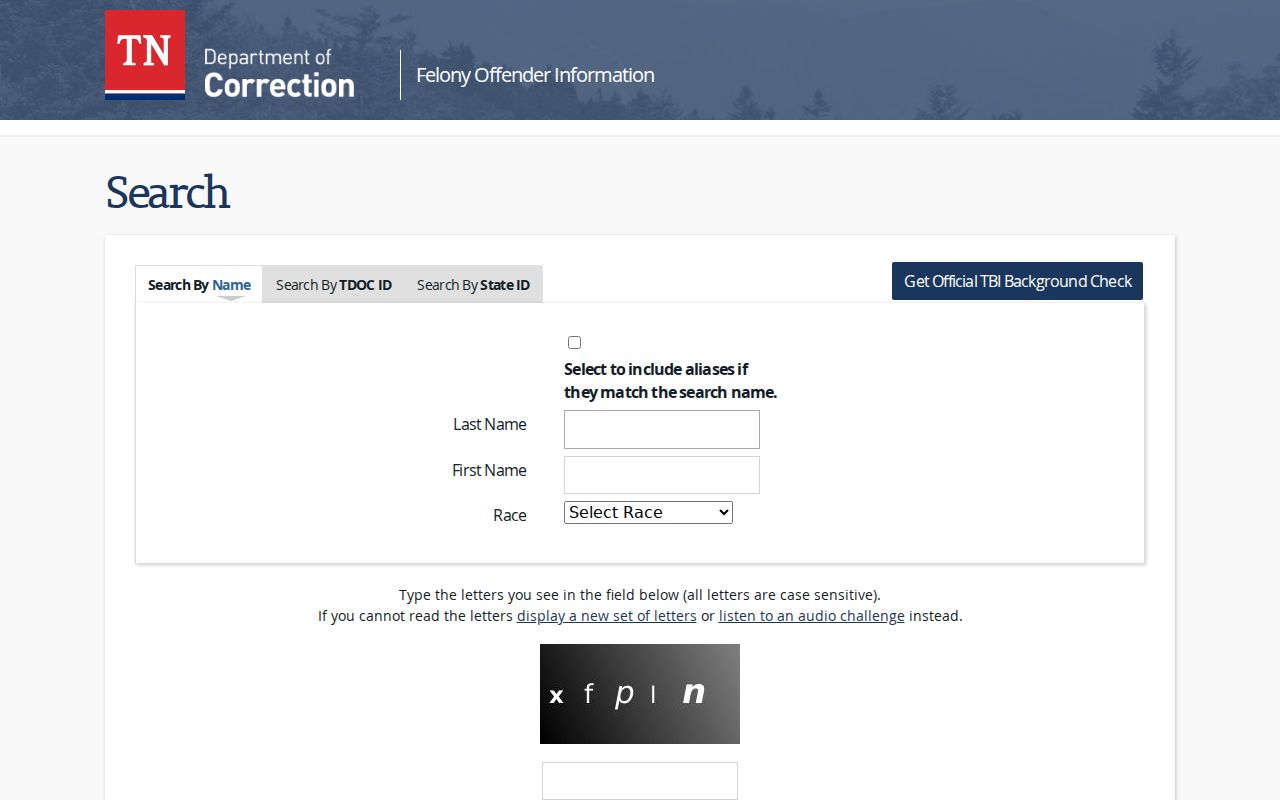
A FOIL result may show status, location, offenses, sentence, and release or parole data. Verify it with the originating jurisdiction because agencies submit the source information.
The TBI registry is another distinct dataset with name and geographic search controls. Registry records are not permission to threaten, intimidate, stalk, harass, or contact a listed person. VINE serves yet another purpose by offering confidential custody-status notifications. Keep booking, charge, conviction, sentence, supervision, and registry duty separate when matching names.
Official Memphis Records Versus Compilations
Commercial compilations can be fast, but they may merge namesakes, repeat stale addresses, or hide source dates. Official records are narrower and take more work, yet each identifies a custodian, event, and record context. Neither category should be treated as proof without checking the underlying filing.
| Source type | Strength | Main limit |
|---|---|---|
| Official index | Points to a named filing or current agency record | May omit images, older years, sealed files, or later changes |
| Certified copy | Authenticated by the records custodian | May require eligibility, a fee, or a focused request |
| Commercial compilation | Combines data for convenience | Can be stale, incomplete, or combine different people |
| Historic directory | Captures a person at a stated time and place | Reflects one edition and may contain publication lag |
Use two non-sensitive points to distinguish a common name, such as a middle initial plus a parcel ID, business role, case number, department, or year. Never resolve a namesake from age or address alone.
When Memphis Search Results Stop
Online silence has many causes. A database may start after the event, an image may be available only at a counter, or the name may have been indexed under initials, a prior surname, or a misspelling. Court files may be sealed or expunged. Recent vital records require entitlement. Private groups may lawfully keep their rosters private. A street can also change names while its parcel identity remains the same.
Use the full fallback chain. Save the no-result and every spelling or date tried. Call the specific custodian, ask for counter-terminal help, and request a defined record rather than “everything” about one person. For land records, give the party, date, instrument type, and book/page. For courts, give the division and case number. For old residents, move to County Archives, the library’s local-history desk, University Special Collections, or state archives and microfilm.
Memphis archival geography can extend beyond Tennessee. The University’s Mississippi Valley Collection reaches into North Mississippi, East Arkansas, and the Missouri Bootheel, reflecting the city’s regional ties. A person who disappears from a Memphis directory may reappear across a state line, so search adjacent jurisdictions when the documented trail points there.
Note: A missing web hit is a prompt to change channels, not a factual finding about the person.
Keeping Memphis People Searches Safe
Public access does not erase privacy law or personal boundaries. Use Memphis records for lawful family research, estate work, civic review, scam checks, or reconnection that respects consent. Tennessee harassment and stalking laws focus on conduct, intent, and effect. Threats, intimidation, repeated unwanted contact, and misuse of a registry can lead to criminal or civil consequences.
Safe at Home gives qualifying Tennessee participants a substitute government mailing address and mail forwarding. It does not erase past records or change identity, and real-property appraisal, tax, and recorded-instrument systems are important exceptions. That can explain why addresses differ across sources without making protected information fair to pursue.
Be cautious when an unsolicited caller seems credible because they know a birth date or former address. Tennessee officials warned in 2024 that jury-duty imposters used such facts and spoofed numbers before demanding payment. Hang up and call the agency through its published number. Government offices do not settle threats with gift cards, wire transfers, cryptocurrency, or payment apps.
Lawful-use limit: Never use a Memphis search result to stalk, harass, threaten, intimidate, or harm anyone. Confirm consequential facts with the office that created the record.