
Which Memphis Records Are Open
Memphis is the Shelby County seat, yet City Hall does not keep every local file. The city controls municipal citations, permits, police reports, and administrative material. County offices keep deeds, appraisal rolls, marriage licenses, probate files, and most trial-court records. Tennessee agencies hold appellate dockets, statewide vital certificates, business filings, and several custody or registry databases. Public access therefore depends on both the record type and the office that created it.
| Record family | Keeper | Web access | Access rule or fallback |
|---|---|---|---|
| Deeds, mortgages, liens, plats | Shelby County Register | Register land-record search | Public index; office or Archives for copies and older series |
| Property roll and GIS | Assessor and ReGIS | Current appraisal and parcel systems | Free finding tools; recorded deed controls title |
| City and county courts | Separate clerks | Varies by court division | Clerk counter or targeted copy request |
| Appellate cases | Tennessee courts | Public Case History | Appeals filed after September 1, 2006 |
| Vital certificates | County Health and Tennessee Vital Records | No open recent-name index | Entitlement, ID, and a $15 search or copy fee |
| City permits and files | Memphis departments and Law Division | Portal or department account | Inspection, online request, phone, or fax |
| Custody and registries | Sheriff, TDOC, and TBI | Separate official lookups | Verify status with the originating agency or clerk |
The Tennessee Public Records Act begins with access to government records unless another law makes them confidential. That presumption does not open sealed cases, adoption records, confidential juvenile files, expunged records, protected personal identifiers, or recent vital certificates. A voter file also follows its own political-purpose rule. The detailed registration limits belong with the Memphis voter registration lookup, not a general open-record request.
Search Memphis Deed Records
The Shelby County Register of Deeds and Archives is the central source for recorded land instruments. Its holdings include titles, mortgages, tax liens, bankruptcy documents, contracts, powers of attorney, real-estate conveyances, marriage settlements, affidavits, and military discharges. Some sensitive instruments need special handling. Start with a party name, then use the document number, book and page, instrument type, and recording date to separate namesakes.
| Search key | Input type | How it narrows a result |
|---|---|---|
| Party or name | Grantor, grantee, or other indexed party | Finds people and entities tied to a filing |
| Instrument number | Document identifier | Retrieves a known filing directly |
| Book and page | Recorded volume reference | Bridges older citations to the stored record |
| Document type | Instrument category | Separates deeds, liens, plats, powers, and affidavits |
| Recording dates | Date range | Limits results to the likely filing period |
An index is a catalog entry, not the complete instrument. The image may add execution dates, a legal description, and cross-references. If no image appears, save the party spelling, date, type, and book/page before calling the Register. The office can explain whether an unofficial image, plain copy, or certified copy is available. Its accessible landing page does not state one universal earliest online year, so older records must be checked by series.
Read Memphis Property Records
The Shelby County Assessor property search reports the owner attributed on the tax roll, a parcel ID, the property or situs address, and an owner mailing address. A situs address marks where the land lies. The mailing address is where tax correspondence goes. Those two fields can differ, and neither proves that a named owner lives at the property. Appraisal values, land and building traits, classification, sales history, and exemption indicators may also appear.
Use the Shelby Parcel Identification viewer to search an address, parcel ID, or owner name and click the mapped tract. Its layer list and basemap controls help reconcile boundaries. Then carry the parcel number into the Register index and compare the newest deed. If either portal fails, call or visit the Assessor with the parcel ID and tax year, then use the Trustee for tax status or Planning and Develop 901 for permit records.
Note: An appraisal record shows tax-roll attribution, while the most recently recorded deed is the stronger source for legal title.
Route Memphis Court Records
Memphis court files are divided by level and case type. City Court handles traffic and municipal tickets. Shelby General Sessions, Circuit, Chancery, Criminal, Probate, and Juvenile courts maintain separate records, even when offices are associated with 201 Poplar. The first step is to identify the issuing agency, case category, and likely clerk. A broad request sent to the wrong clerk delays the search and may prompt a request for clarification.
Tennessee Public Case History searches appellate matters by case number, case style, individual party, or organization. It covers appeals with records filed after September 1, 2006 and is current through the prior business day. It is not a statewide trial-court index. For a full Shelby file, use the proper local portal if available, then ask the clerk for a docket, pleading, image, or certified copy by case number. Counter terminals may show items that the open web does not.
- Custodian
- The government office that creates, receives, or keeps a record.
- Docket
- The case event list showing filings, orders, hearings, and status changes.
- Certified copy
- A copy authenticated by the keeper for an official purpose.
- Exemption
- A law that withholds all or part of an otherwise requested record.
Memphis Vital Records Stay Controlled
Birth, death, marriage, and divorce certificates are not an open people directory. Tennessee Vital Records applies T.C.A. §§ 68-3-205 and 68-3-206 and Rules 1200-07-01-.11 and -.12. Its entitlement guidelines require a qualifying relationship, identification, or documented authority for recent certified copies. The genealogy framework uses 100 years for births and 50 years for deaths. Older divorce records come from the granting court and may eventually reach the Tennessee State Library and Archives.
The Tennessee Vital Records application list provides separate forms for birth, death, marriage, and divorce certificates.
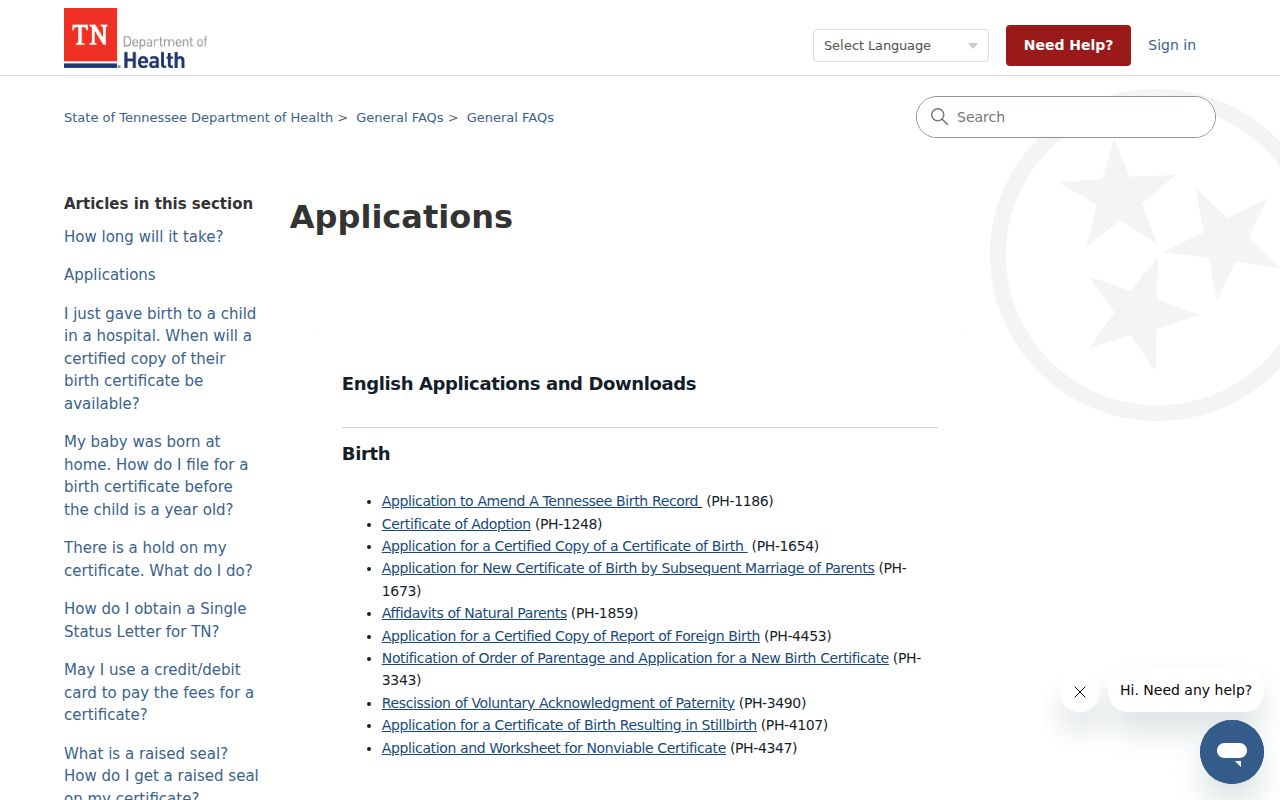
The form set makes the controlled route clear: select the right event application, show entitlement, include the required ID or notarization, and pay $15 for each search or copy. Mail requests take a signed form, check or money order, and qualifying identification. Shelby County Health Department can issue statewide registered birth and death certificates, while Tennessee handles the broader certificate system. The state also identifies an authorized online card vendor, but does not itself take online orders directly.
Memphis Public Records Custodians
The best office is the one responsible for the exact record. The Register handles recorded instruments and its Archives. The Memphis Law Division routes city requests. Court clerks keep their own case files. A phone call before travel can confirm whether the office has the series, whether inspection needs an appointment, and which identifier will help staff retrieve it.
Shelby County Register of Deeds
1075 Mullins Station Road, Building W3 Suite W165, Memphis, TN
(901) 222-8100
Register contact and records access
Memphis Law Division
Monday through Friday, 8:30 a.m. to 5 p.m.
(901) 636-6616
City records request portal
Memphis and Shelby Court Clerks
City Court and several county court offices are associated with 201 Poplar.
Tennessee Records Response Clock
Tennessee citizens may inspect records under the Tennessee Public Records Act, T.C.A. §§ 10-7-501 et seq. A custodian may ask for proof of citizenship. When a record is readily available, the office should provide prompt access. If prompt production is not practical, the custodian must act within seven business days by producing the record, denying access in writing with the legal basis, or giving a written estimate of when production will occur.
A denial is not always the final word. First confirm that the request reached the correct custodian and narrow unclear dates or record categories. The Tennessee Office of Open Records Counsel publishes forms, policies, and guidance and may assist with mediation. T.C.A. § 10-7-505 provides the court petition route when access remains unlawfully denied.
Costs for Memphis Records Copies
Inspection generally is free unless a specific law says otherwise. Copies are different. The statewide reasonable-charge schedule uses safe-harbor rates of $0.15 per letter or legal black-and-white page and $0.50 per color page. An office may charge reasonable labor after the first hour, provide an estimate, and require advance payment. A clerk, Register, or vital-record office may apply a separate authorized fee for certification or a specialized record product.
Ask what product is needed before paying. A free index result can identify a filing, an unofficial image can help with research, a plain copy reproduces the file, and a certified copy carries the custodian's authentication. For broad electronic requests, define the date range, department, subject, and format. That reduces needless searches and makes a labor estimate easier to judge.
Note: A no-record result on a Tennessee vital search does not refund the $15 search fee.
Find Memphis Records Offline
Not every index is complete on the web. For recorded land, preserve the name, rough date, instrument type, and book/page, then call the Register or visit its counter. For property, take the parcel ID and tax year to the Assessor. For courts, give the clerk a case number or a party name, year range, and case category. Ask whether a counter terminal contains a docket or scan that the public portal omits.
City administrative files can be requested through the online portal linked by the Law Division. The division also provides phone and fax routing. Describe the record, the date range, the likely city department, and whether inspection or copies are preferred. Police or crash requests are easier to route with an incident number, date, location, and named party. Historical newspapers and directories move to Memphis Public Libraries, while permanent county series belong with Shelby County Archives.
The Memphis Law Division records page links the official city submission route and lists the office contact channels.

The city screen is the starting point for non-indexed municipal material, not for county deeds or Shelby court files. Send those to their own custodians.
Safe at Home Has Limits
Tennessee Safe at Home supplies a substitute government mailing address and forwarding service to qualifying victims. It can protect participant information in many government settings. It does not erase old files, change a person's identity, or delete a lawful record. The program also has a notable property boundary: the substitute address cannot be used for appraisal and assessment, property-tax collection, or a recorded real-property instrument.
That limit can explain why a protected person's voter information and property trail seem inconsistent. Voter registration uses a separate secure process, while appraisal and deed systems retain the real-property data required by law. T.C.A. § 10-7-504 also protects specified personal data, including identifiers submitted to a government property-alert service.
Privacy does not mean erasure. Correct a wrong public record with its originating custodian. A commercial removal request cannot change a court, deed, voter, or agency file.
Memphis Registry Records Require Care
Custody and registry tools answer narrow questions. The Shelby County jail lookup concerns current local custody. Tennessee FOIL covers current and former felony offenders under state custody or supervision. The TBI offender registry is a separate, daily updated statutory database. A booking, charge, conviction, sentence, supervision status, and registry duty are not interchangeable facts. Confirm a filed charge or court disposition with the correct clerk.
The Tennessee Bureau of Investigation registry provides name and geographic search controls as well as record-detail links.
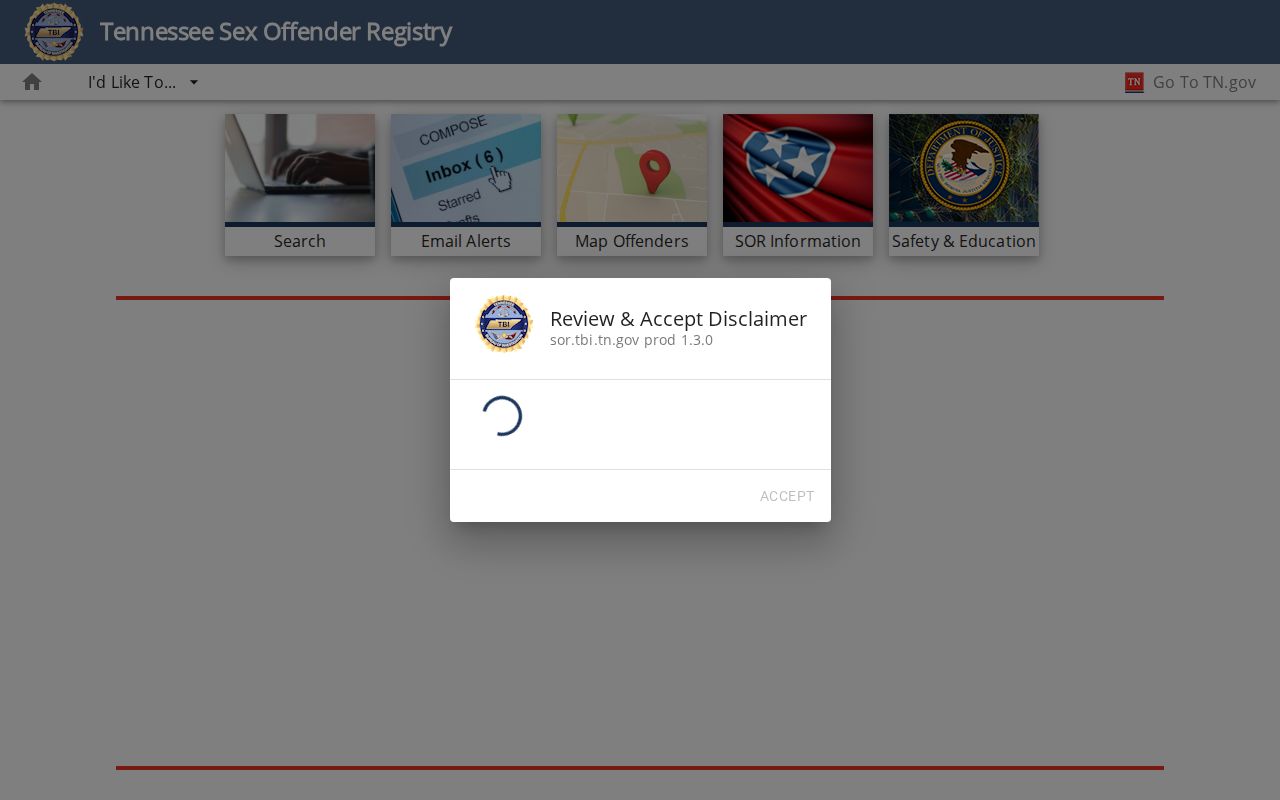
The interface may show identifying, status, address, and offense data reported to the state, but it also warns against threats, intimidation, stalking, or harassment. Use the result only for a lawful purpose, check identity carefully, and follow corrections or tips through the official controls.
Memphis Archives Before Digital Access
Shelby County's first record-making court met in a log cabin near Main and Winchester in 1820. Modern online access sits on top of two centuries of changing books, indexes, microfilm, and automated systems. The Register reports that automation shortened return of original filings from three to six weeks to roughly 36 hours, but it does not publish one cutover date or one starting year for every database.
The Archives is therefore a core access channel, not a last resort. It holds permanent county material, old court records, death and marriage resources, maps, aerials, and unusual collections such as Health Department milk-supply photographs and the MLK assassination investigation records. Ask staff for the record group and year. For statewide historical indexes and county microfilm dates, search the Tennessee State Library and Archives catalog as well.
Request Memphis Public Records
A useful request asks for existing records, not an office to research a person or answer a broad question. Choose the city, county, court, or state custodian first. Then give enough detail for staff to locate the file without guessing. State whether inspection, electronic copies, plain paper copies, or certification is needed.
- Identify the record family and the office that created or keeps it.
- Check the official index or portal, and save any case, parcel, instrument, incident, or permit number.
- Submit a narrow request with names, subject, date range, likely department, and preferred format. Use the portal, mail, fax, or in-person channel that office provides.
- Review any estimate. Ask the custodian to explain copy, certification, or labor charges before approving costly work.
- If access is denied, read the cited exemption, clarify or narrow the request, and consult Open Records Counsel before considering a petition.
Lawful personal use. Open access does not permit threats, repeated unwanted contact, intimidation, stalking, or harassment. Verify identity and context with the originating custodian before relying on a result.
Good routing matters most in Memphis because city and county offices often sit side by side in a search result but keep different files. A precise request protects time, limits fees, and gives the custodian a clear basis for a prompt response.